The best competitive intelligence tools in 2026 fall into two groups. Three publish a price you can buy without a sales call: Debriefing (the tool we make, $80 a month, no contract), Similarweb and Visualping. The other six (Crayon, Klue, Contify, Kompyte, AlphaSense and Valona) are quote-only, so you learn the price after a demo (checked October 23 and 25, 2026).
To see where you stand against one rival before you pick a platform, run the free competitor analysis tool. It reads both websites once and writes a snapshot, a SWOT and a battlecard.
How we ranked these tools
We used one test a buyer can repeat: can you see the price and start without an annual contract? Tools that pass come first. We make Debriefing, so we say so, and it is first because it passes the test and does the analysis for you. Inside each group we rank by how much the tool monitors and who reads the output.
For each tool we show its homepage, the price, what it monitors, who it fits, and its pros and cons. We read each price, or the absence of one, on the vendor’s own site, and we give the date next to it. When a vendor shows no price, we say so, because a missing price is a fact a buyer needs.
Competitive intelligence has two halves. The first is monitoring: watching the pages, feeds and filings where competitors leave evidence. The second is analysis: deciding what a change means and telling the team what to do. A tool can be strong at one half and thin at the other, so we mark which half each tool does well.
Best competitive intelligence tools in 2026
1. Debriefing: the analysis done for you (the tool we make)
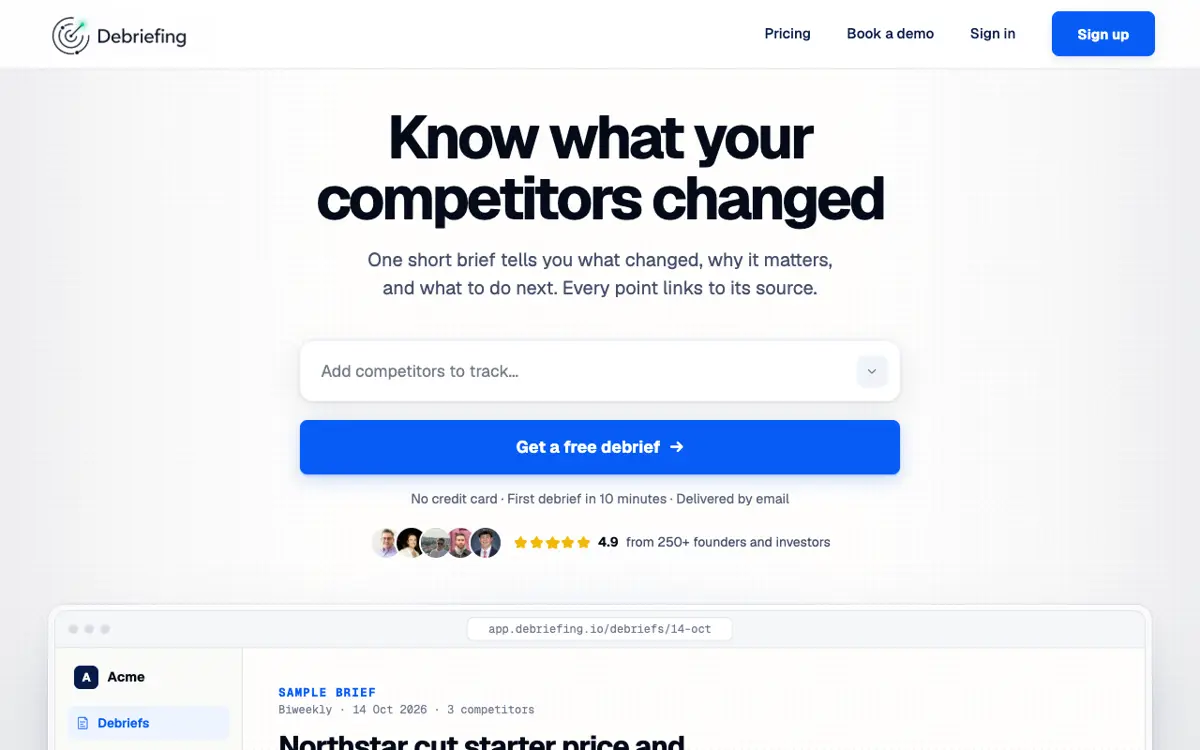
Debriefing monitors a chosen set of competitors across six signal categories: product and pricing, AI and automation, hiring and team, funding and M&A, content and distribution, and market and regulation. It watches competitor pricing pages, changelogs, careers pages, homepages and integrations pages, and it reads 80+ web sources for news and reviews. It sends a written brief on a schedule. Each brief opens with a TLDR and recommended actions, then the signal detail, with the evidence attached to every finding.
- Price: From $80 a month, billed monthly, no contract. The first brief is free and needs no card (debriefing.io/pricing, checked October 23, 2026).
- Monitors: Competitor pricing, changelog, careers, homepage and integrations, plus 80+ web sources.
- Best for: A company of 20 to 249 people that wants the analysis done for it and a price it can see.
- Pros: Public monthly price. Every finding links to its source. A free first brief before you pay.
- Cons: No self-serve dashboard for ad-hoc queries. The product is the brief.
2. Similarweb: competitor traffic and digital data
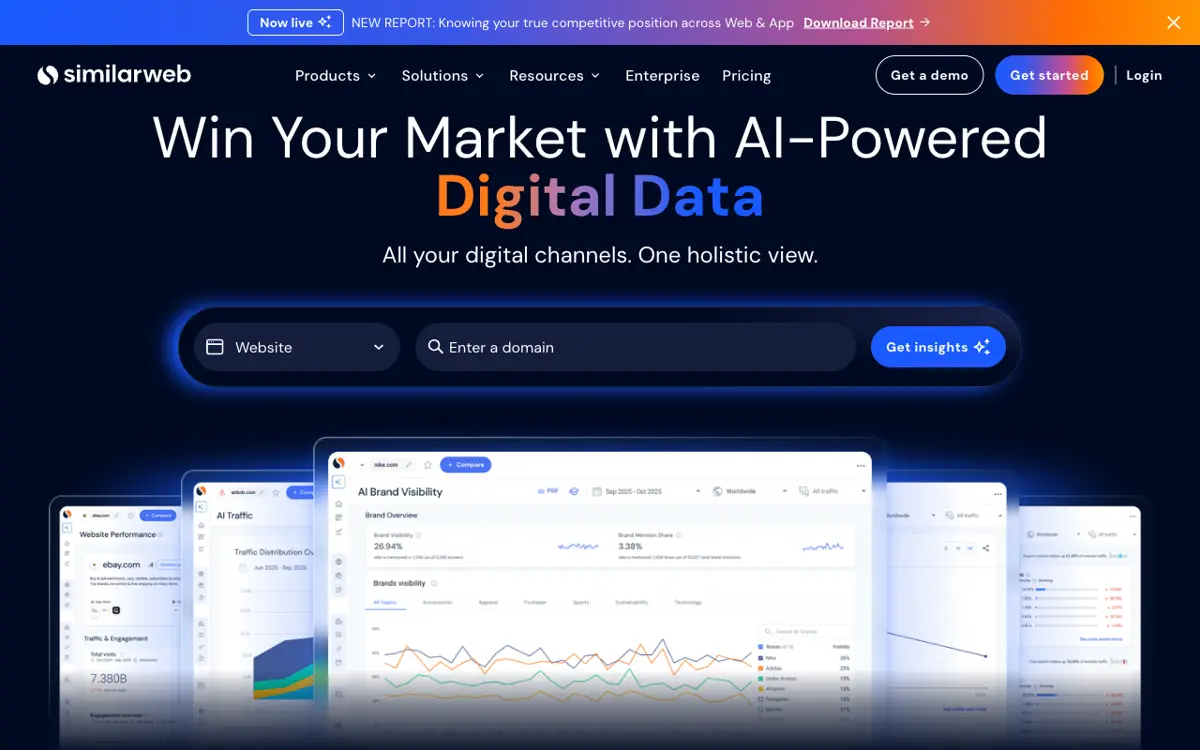
Similarweb estimates the website traffic, engagement and audience of any domain, and it sends alerts when a competitor’s numbers move. It shows how a rival grows, not what it changed on its site.
- Price: The “Competitive Intelligence” plan is $125 a month billed annually, or $199 billed monthly, for 1 user. Self-serve plans have a free trial (similarweb.com/packages/web, checked October 25, 2026).
- Monitors: Website traffic, engagement, demographics and competitor alerts.
- Best for: Researchers and analysts who benchmark competitors on traffic.
- Pros: Public price, a monthly option and self-serve signup.
- Cons: Traffic data only at this tier. The SEO and ads data cost more ($333 and $542 a month billed annually), and it does not tell you what a change means.
3. Visualping: page-change alerts on a budget
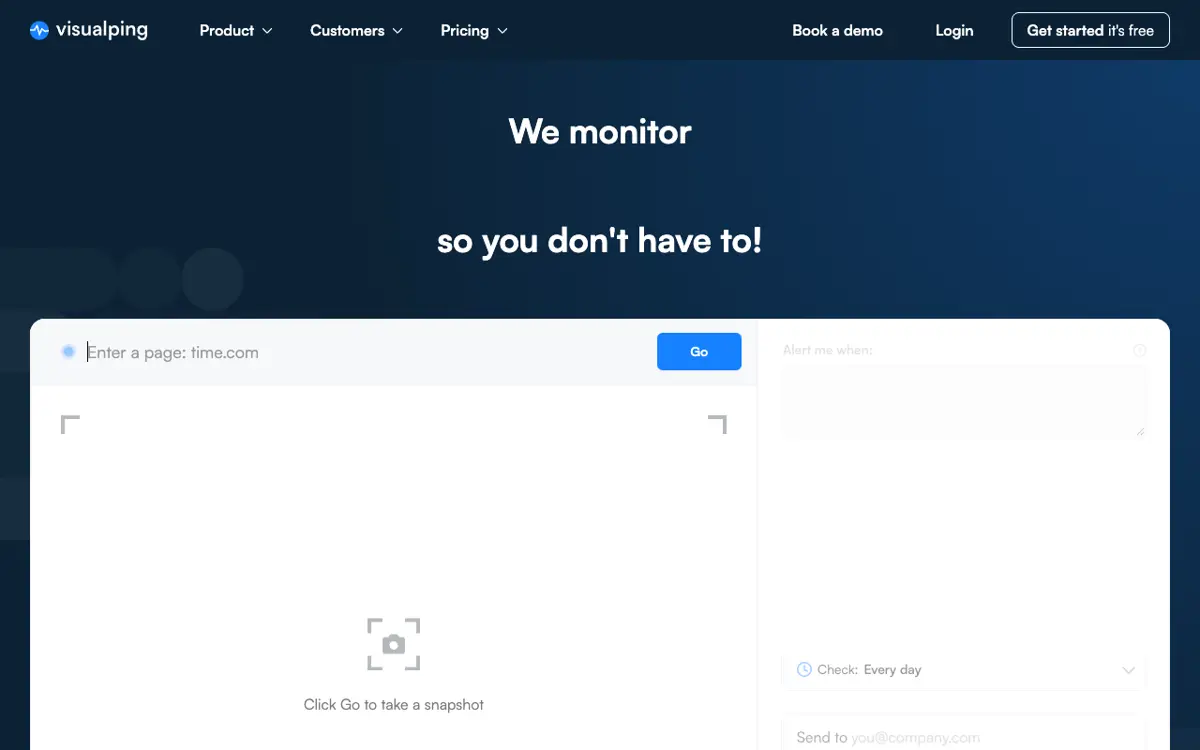
Visualping watches web pages and emails you when they change. Point it at a competitor’s pricing, product or careers page and it alerts you to each edit.
- Price: A free plan (150 checks a month, 5 pages, no card). Paid plans start at “Personal 1K”, $14 a month or $120 a year. The cheapest business plan, “Business 20K”, is $140 a month or $1,200 a year, month-to-month or annual, with a 14-day trial (visualping.io/pricing, checked October 25, 2026).
- Monitors: Changes on competitor homepages, pricing, product and career pages, reviews and social.
- Best for: Strategy and research teams that want raw change alerts and will read them themselves.
- Pros: Cheap, self-serve, and a free plan that is useful on its own.
- Cons: Alerts with no analysis. You decide what each change means.
4. Crayon: widest automated monitoring
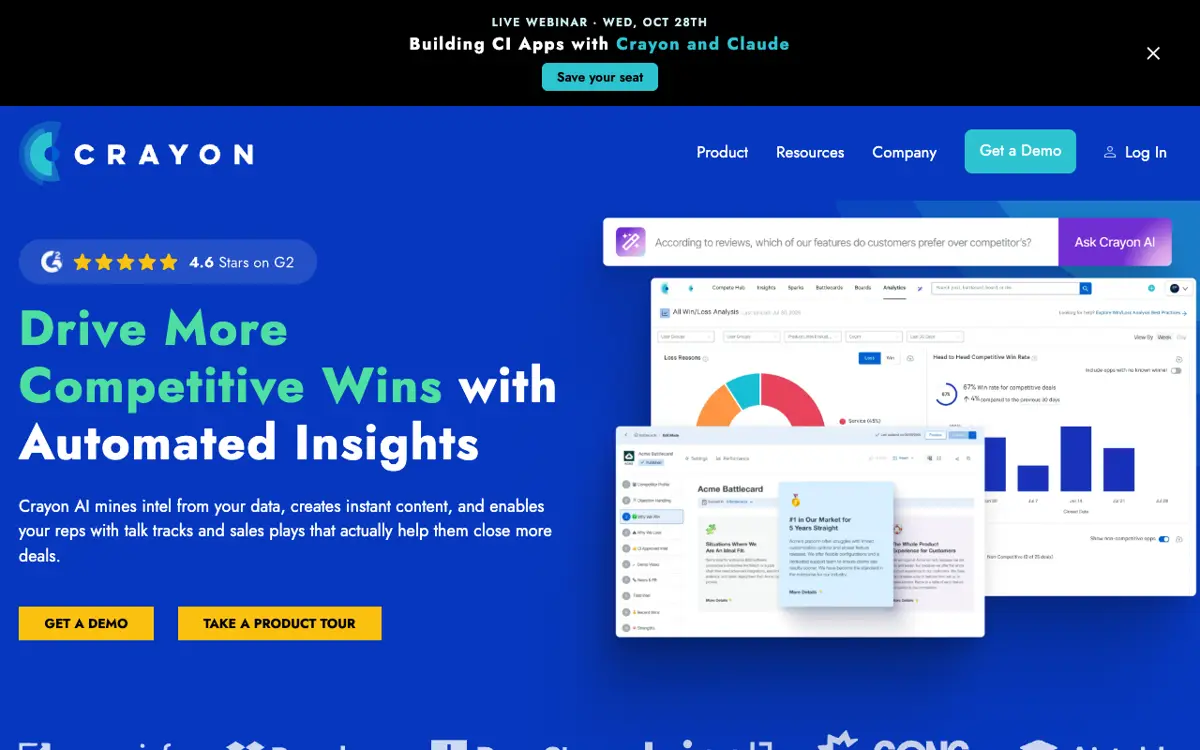
Crayon tracks the most signal types of any standalone platform here. It watches competitor websites, news, reviews, job postings and filings, then scores the signals with AI so an analyst can triage the volume.
- Price: No public price. The pricing page shows “Request an Estimate” and a demo request, with no figure and no plan (crayon.co/pricing, checked October 25, 2026). Annual contract.
- Monitors: Websites, news, reviews, job postings, filings.
- Best for: A cross-functional CI program with a dedicated analyst to read a high signal volume.
- Pros: The widest automated collection here. AI scoring helps triage.
- Cons: No built-in win/loss module. Small teams drown in the signal volume without a person to curate it. See the Crayon competitive profile.
5. Klue: battlecards and win/loss for sales
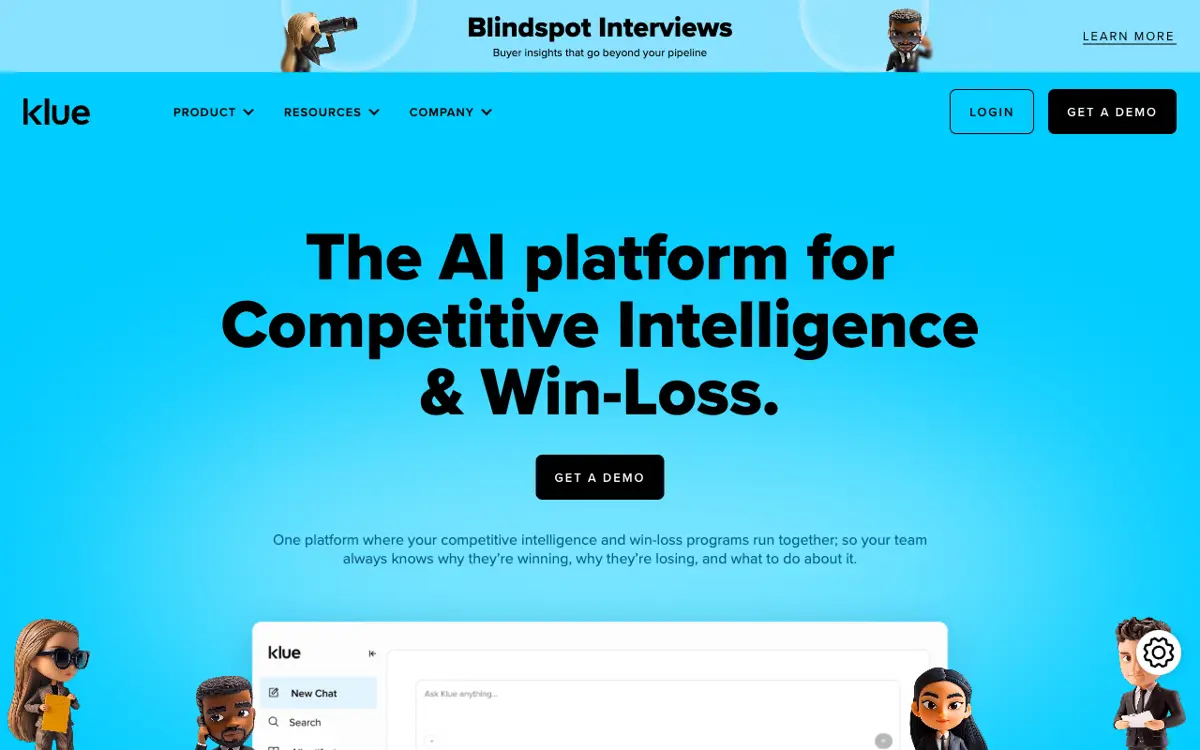
Klue is a competitive enablement platform. It turns monitoring into battlecards that reps open inside Salesforce during live deals, and it includes a win/loss module.
- Price: No public price. The pricing page shows “Get a Demo”, with no figure and no plan (klue.com/pricing, checked October 25, 2026). Annual contract.
- Monitors: Curated competitor intel plus some automated monitoring.
- Best for: A sales-led team with many reps and a product marketer to keep battlecards current.
- Pros: The best battlecard delivery inside the CRM. Win/loss in the same platform.
- Cons: Built for sales. Founders and strategy leads get less from it, and content decays fast without an owner. See the Klue alternatives page.
6. Contify: news and market intelligence
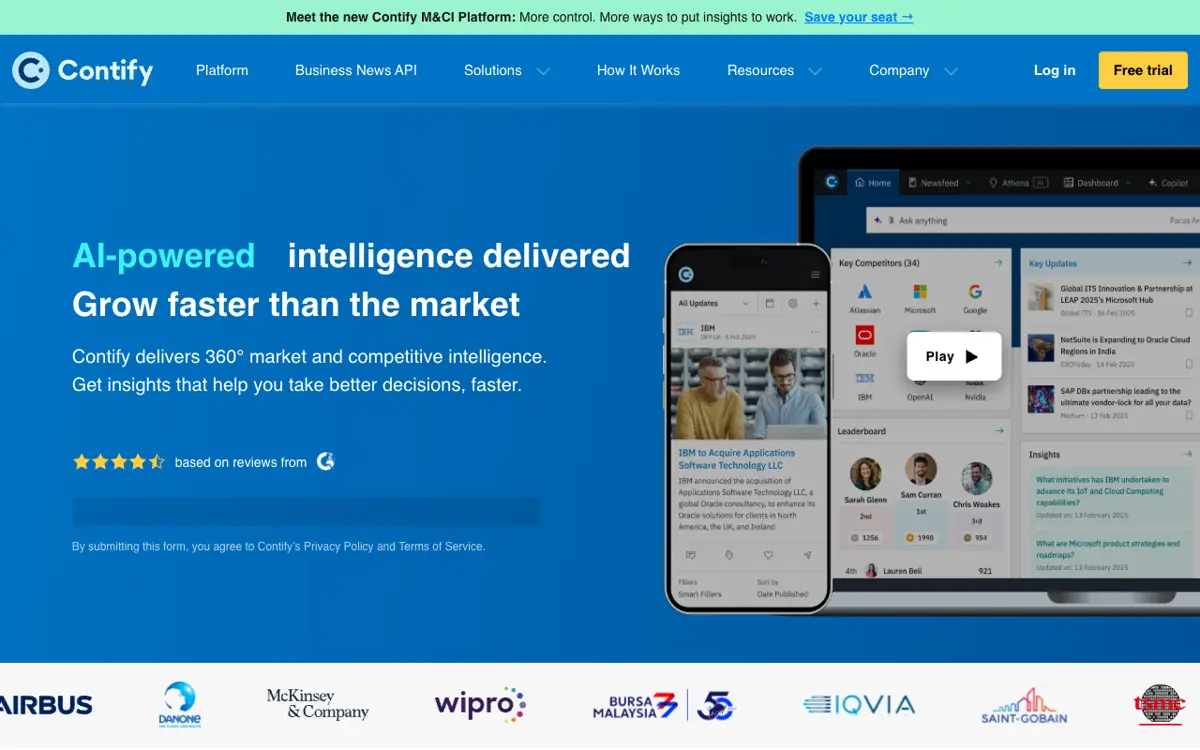
Contify is built around news. It monitors a large set of sources, sorts them with a taxonomy, and sends digests to stakeholders who never log in.
- Price: No public price. The page offers a demo and a 7-day free trial, with no figure and no plan (contify.com/pricing, checked October 25, 2026). Annual contract.
- Monitors: News, press and market sources at scale, with multilingual coverage.
- Best for: A strategy, marketing or analyst team that wants broad news coverage and automated digests.
- Pros: Broad news coverage. A free trial before the sales call.
- Cons: Light on direct website-change monitoring. Battlecard features are basic. See the Contify alternatives page.
7. Kompyte: monitoring for teams already in Semrush
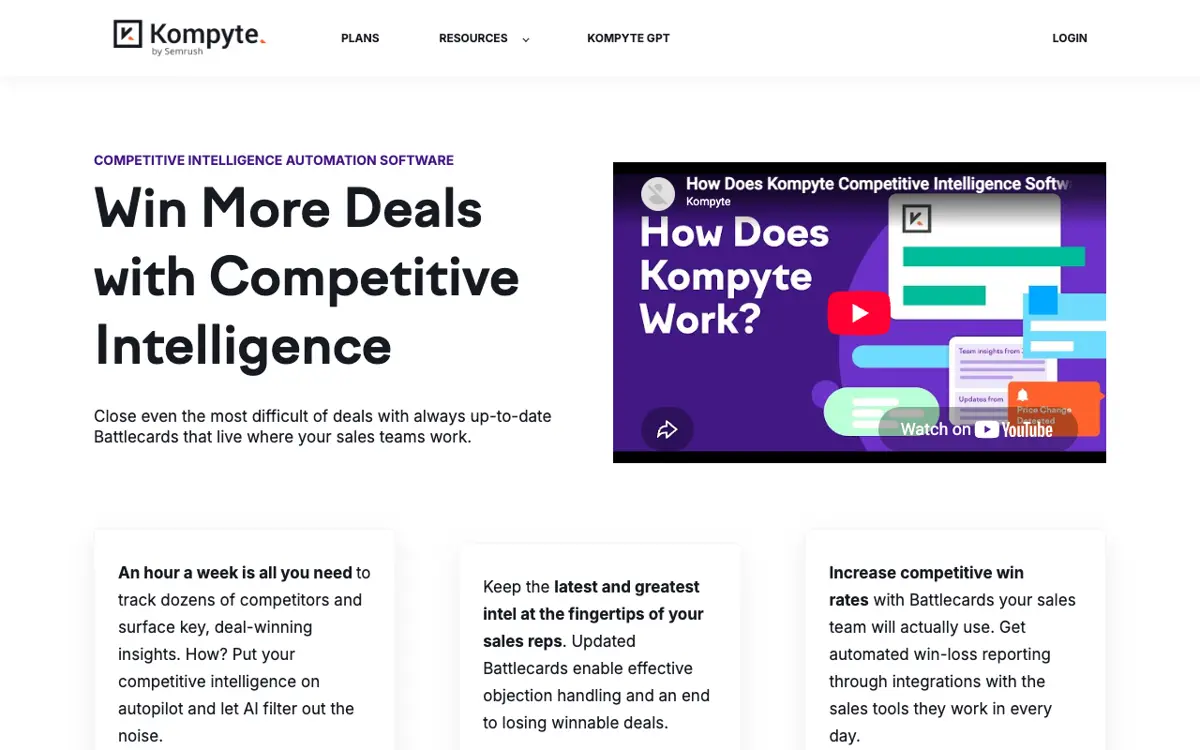
Kompyte adds competitor monitoring and battlecards, and Semrush now sells it. Its data pairs with Semrush’s digital-marketing intelligence.
- Price: No public price. kompyte.com/pricing returns a 404, and Kompyte is quoted through the Semrush sales process (checked October 25, 2026). Annual contract.
- Monitors: Website and digital-marketing changes, with battlecards on top.
- Best for: A marketing team that already pays for Semrush.
- Pros: Pairs with Semrush data you may already buy.
- Cons: Battlecard and win/loss features are shallower than Klue’s, and the value depends on a separate Semrush subscription. See Kompyte pricing and alternatives.
8. AlphaSense: market research for finance and strategy
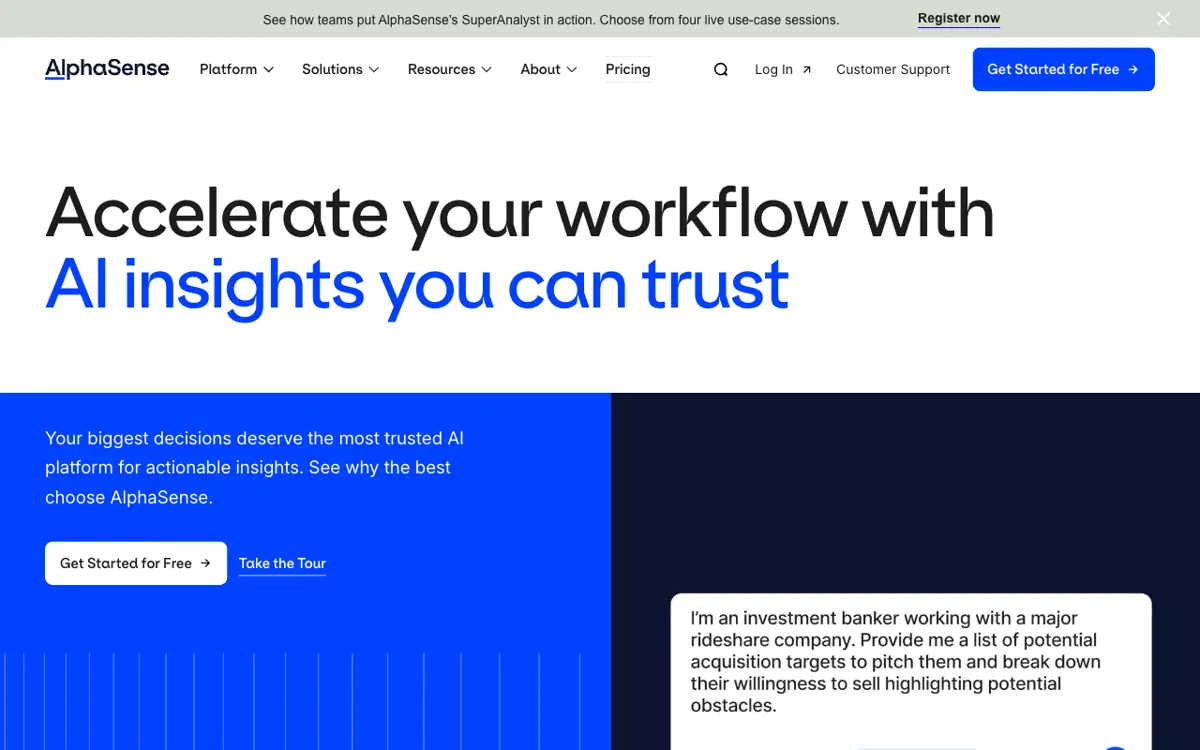
AlphaSense searches a large library of business content: broker research, expert call transcripts, company filings and financial data. Analysts use it to research a market or a company in depth.
- Price: No public price. The pricing page asks you to connect with sales, and it sells annual subscriptions for all team sizes (alpha-sense.com/pricing, checked October 25, 2026).
- Monitors: “500M+” documents, including broker research, expert transcripts and filings.
- Best for: Finance, corporate strategy and consulting firms.
- Pros: Deep paywalled content, including expert calls, that no other tool here has.
- Cons: Annual contract through sales. The content is built for finance research, not for tracking three or four SaaS rivals.
9. Valona Intelligence: broad market intelligence for industrial firms
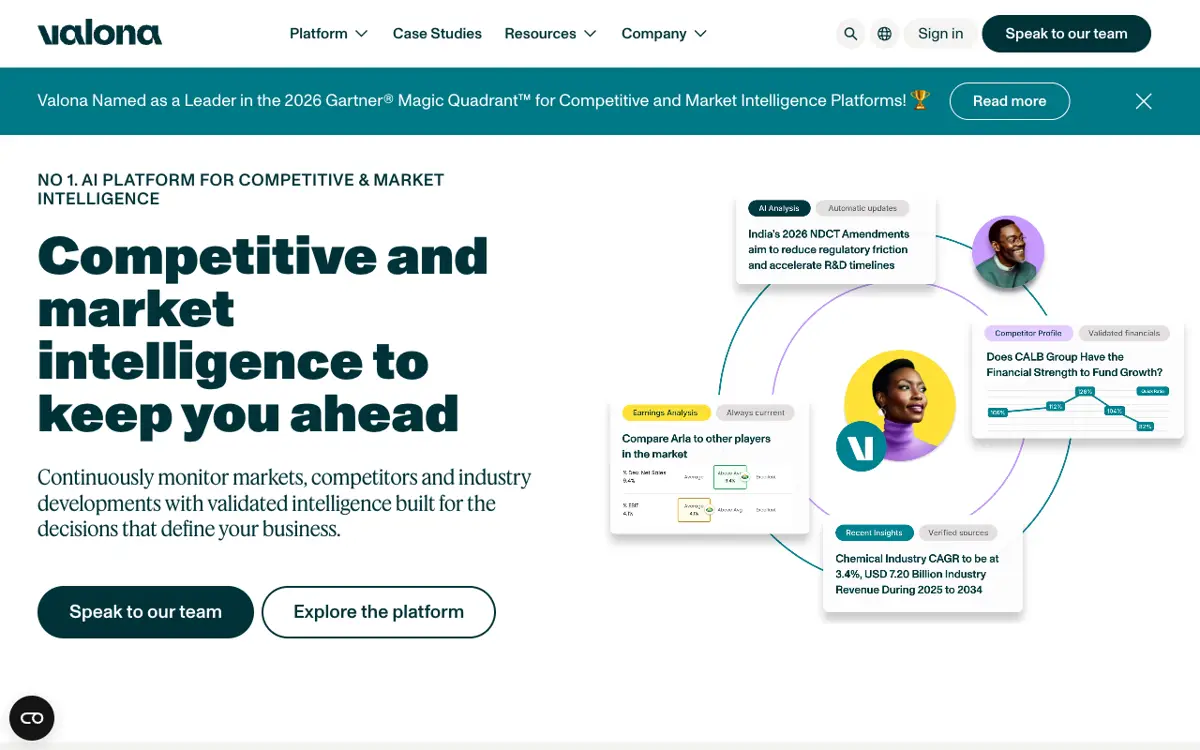
Valona monitors markets, competitors and industry news across a very wide source set, and it adds AI analysis on top. Its customers are mostly large industrial companies.
- Price: No public price. The pricing page offers “tailored packages” through sales (valonaintelligence.com, checked October 25, 2026).
- Monitors: “200,000+ global and local sources”, including 280+ paywalled sources, filings, trade, regulatory and patent data, in 115+ languages.
- Best for: Intelligence and strategy teams in manufacturing, chemicals, automotive and medtech.
- Pros: The widest source coverage here, in many languages.
- Cons: A sales call to see any price, and a focus on industrial markets. See Valona alternatives.
Comparison table
| Tool | Public self-serve price? | Lowest plan you can buy without a sales call | Annual contract? | What it monitors | Price checked |
|---|---|---|---|---|---|
| Debriefing | Yes | $80/mo, first brief free | No | Pricing, changelog, careers, homepage, integrations, plus 80+ sources | Oct 23, 2026 |
| Similarweb | Yes | $125/mo billed annually, or $199 monthly | No | Website traffic and engagement | Oct 25, 2026 |
| Visualping | Yes | Free plan; paid from $14/mo | No | Web page changes | Oct 25, 2026 |
| Crayon | No | None, quote only | Yes | Websites, news, reviews, jobs, filings | Oct 25, 2026 |
| Klue | No | None, quote only | Yes | Curated intel, battlecards, win/loss | Oct 25, 2026 |
| Contify | No | None, quote only (7-day trial) | Yes | News and market sources at scale | Oct 25, 2026 |
| Kompyte | No | None, quote only (via Semrush) | Yes | Website and digital-marketing changes | Oct 25, 2026 |
| AlphaSense | No | None, quote only | Yes | Broker research, expert calls, filings | Oct 25, 2026 |
| Valona | No | None, quote only | Not stated | 200,000+ news, trade and regulatory sources | Oct 25, 2026 |
What the enterprise platforms do not show you
Six of the nine tools share one habit: the price is a sales call. Crayon asks you to request an estimate. Klue asks you to book a demo. Contify routes to a demo and a trial. Kompyte’s pricing page returns a 404 and routes you to Semrush sales. AlphaSense and Valona ask you to talk to sales. A buyer cannot compare six contracts without six sales calls and a quarter of back and forth.
That matters for a small team for two reasons. First, you cannot budget. The price depends on how many competitors you track and how many seats you need, and you learn your number only after the call. Second, you commit for a year before you know the tool fits. A monthly price with no contract lets you start, read a few briefs, and stop if the output is not worth it.
How to choose
Pick by who reads the output and how much you can commit.
A founder or one marketer reads it. You want the answer, not a feed to triage. Debriefing at $80 a month is built for this, and you can start without a contract.
You only want alerts and will read them yourself. Visualping’s free plan covers a handful of competitor pages.
You benchmark competitors on traffic. Similarweb shows how a rival’s audience grows.
A sales team reads it. Klue puts competitive content inside the CRM better than anything else here. Budget for an annual contract and a person to maintain the battlecards.
A strategy or analyst team reads it. Contify for broad news coverage and digests. Crayon when you need the widest automated collection and have an analyst to curate it. AlphaSense for deep finance research, Valona for industrial markets.
You already pay for Semrush. Kompyte is the monitoring add-on that pairs with the data you already buy.
If you want something cheaper or lighter
If the job is page-change alerts rather than a full CI platform, a free or low-cost monitor covers it. Our guide to the best competitor monitoring tools lists the free and sub-$100 options, with verified prices.
FAQs
What is a competitive intelligence tool?
A competitive intelligence tool collects evidence of what your competitors do, and helps you decide what it means. The collection half watches websites, news, hiring, funding, content and reviews. The analysis half turns that evidence into a brief, a battlecard or a report your team can act on. Some tools do one half well and the other poorly, so match the tool to the half you need most.
How much do competitive intelligence tools cost?
Six of the nine tools here publish no price: Crayon, Klue, Contify, Kompyte, AlphaSense and Valona start with a sales call (checked October 25, 2026). Three publish one. Debriefing costs $80 a month with no contract. Similarweb’s Competitive Intelligence plan costs $125 a month billed annually, or $199 monthly. Visualping has a free plan, and paid plans start at $14 a month. For buyer estimates on a quote-only tool, see our alternatives pages for Klue, Contify and Kompyte.
Which competitive intelligence tool is best for a small team?
A small team rarely has an analyst to read a high signal volume, and a year-long enterprise contract is a large bet before the program has proven its value. A monthly price with no contract fits better. Debriefing is built for a company of 20 to 249 people that wants the analysis delivered as a brief. If the job is only alerts, Visualping’s free plan covers it.
Do Crayon and Klue publish their prices?
No. On October 25, 2026, both pricing pages asked for a demo or an estimate and showed no figure. Both sell annual contracts. You learn the price after a sales call.
Can I try a competitive intelligence tool before I buy?
Yes, with some of them. Visualping has a free plan and a 14-day business trial. Similarweb has a free trial on its self-serve plans. Contify lists a 7-day free trial. Debriefing gives a free first brief that needs no card. Crayon, Klue, Kompyte, AlphaSense and Valona start with a demo.
Method
We read each price, or the absence of one, on the vendor’s own site on October 23 and 25, 2026, and we give the date next to each claim. Where a vendor shows no price, we report that, because a missing price is a fact a buyer needs. We describe what each tool monitors from the vendor’s own site, and the screenshots show each homepage on October 25, 2026. We update this page when a vendor changes its price, its contract terms or what it monitors. To report a change, email team@debriefing.io.